
S90.09 Online Practice Questions and Answers
Service A is an entity service with a functional context dedicated to invoice-related processing. Service B is a utility service that provides generic data access to a database.
In this service composition architecture, Service Consumer A sends a SOAP message containing an invoice XML document to Service A(1). Service A then sends the invoice XML document to Service B (2), which then writes the invoice document to a database.
The data model used by Service Consumer A to represent the invoice document is based on XML Schema
A. The service contract of Service A is designed to accept invoice documents based on XML Schema B. The service contract for Service B is designed to accept invoice documents based on XML Schema A. The database to which Service B needs to write the invoice record only accepts entire business documents in Comma Separated Value (CSV) format.
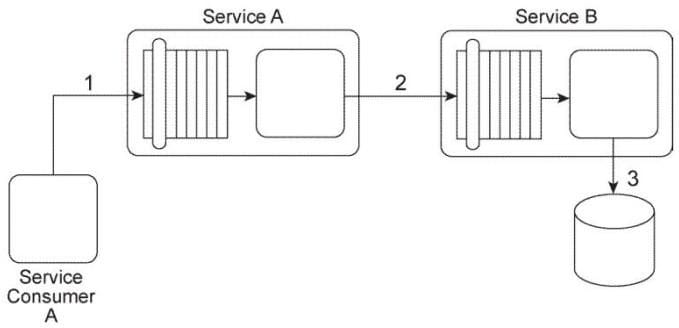
Due to the incompatibility of XML schemas used by the services, the sending of the invoice document from Service Consumer A through to Service B cannot be accomplished using the services as they currently exist. Assuming that the Contract Centralization and Logic Centralization patterns are being applied, what steps can be taken to enable the sending of the invoice document from Service Consumer A to the database without adding logic that will increase the runtime performance of the service composition?
A. The Data Model Transformation pattern can be applied so that the invoice document sent by Service Consumer A is transformed into an invoice document that is compliant with the XML Schema B used by Service A . The Data Model Transformation pattern can be applied again to ensure that the invoice document sent by Service A is compliant with XML Schema A used by Service B.
B. The service composition can be redesigned so that Service Consumer A sends the invoice document directly to Service B. Because Service Consumer A and Service B use XML Schema A, the need for transformation logic is avoided. This naturally applies the Service Loose Coupling principle because Service Consumer A is not required to send the invoice document in a format that is compliant with the database used by Service B.
C. The Standardized Service Contract principle can be applied to the service contract of Service A so that it is redesigned to use XML Schema A. This would make it capable of receiving the invoice document from Service Consumer A and sending the invoice document to Service B without the need to further apply the Data Model Transformation pattern.
D. None of the above.
Service A is a utility service that provides generic data access logic to a database that contains data that is periodically replicated from a shared database (1). Because the Standardized Service Contract principle was applied to the design of Service A, its service contract has been fully standardized.
Service A is being accessed by three service consumers. Service Consumer A accesses a component that is part of the Service A implementation by invoking it directly (2). Service Consumer B invokes Service A by accessing its service contract (3). Service Consumer C directly accesses the replicated database that is part of the Service A implementation (4).

You've been told that the reason Service Consumers A and C bypass the published Service A service contract is because, for security reasons, they are not allowed to access a subset of the operations in the WSDL definition that expresses the service contract. How can the Service A architecture be changed to enforce these security restrictions while avoiding negative forms of coupling?
A. The Contract Centralization pattern can be applied to force all service consumers to access the Service A architecture via its published service contract. This will prevent negative forms of coupling that could lead to problems when the database is replaced. The Service Abstraction principle can then be applied to hide underlying service architecture details so that future service consumers cannot be designed to access any part of the underlying service implementation.
B. The Contract Centralization pattern can be applied to force service consumers to access the Service A architecture via its published service contract only. The Service Loose Coupling principle can then be applied to ensure that the centralized service contract does not contain any content that is dependent on or derived from the underlying service implementation.
C. The Concurrent Contracts pattern can be applied to Service A in order to establish one or more alternative service contracts. This allows service consumers with different levels of security clearance to continue accessing the service logic via its published service contracts.
D. None of the above.
Service A is a task service that sends Service B a message (2) requesting that Service B return data back to Service A in a response message (3). Depending on the response received. Service A may be required to send a message to Service C (4) for which it requires no response. Before it contacts Service B, Service A must first retrieve a list of code values from its own database (1) and then place this data into its own memory. If it turns out that it must send a message to Service C, then Service A must combine the data it receives from Service B with the data from the code value list in order to create the message it sends to Service C. If Service A is not required to invoke Service C, it can complete its task by discarding the code values.
Service A and Service C reside in Service Inventory A. Service B resides in Service Inventory B.

You are told that the services in Service Inventory A are all SOAP-based Web services designed to exchange SOAP 1.1 messages and the services in Service Inventory B are SOAP-based Web services designed to exchange SOAP 1.2 messages. Therefore, Service A and Service B cannot currently communicate. Furthermore, you are told that Service B needs to access a shared database in order to retrieve the data required by Service A. The response time of the database can sometimes be lengthy, which would cause Service A to consume too much resources while it is waiting and keeping the code values in memory. How can this service composition architecture be changed to avoid these problems?
A. The Protocol Bridging pattern can be applied by establishing an intermediate processing layer between Service A and Service B that can convert SOAP 1.1 messages to SOAP 1.2 messages and vice versa. The Service Data Replication pattern can be applied to Service B so that it is given a dedicated database with its own copy of the data it needs to access. The Service Normalization pattern can then be applied to ensure that the data within the replicated database is normalized with the shared database it is receiving replicated data from.
B. The Protocol Bridging pattern can be applied by establishing an intermediate processing layer between Service A and Service B that can convert SOAP 1.1 messages to SOAP 1.2 messages and vice versa. The Service Statelessness principle can be applied with the help of the State Repository pattern so that Service A can write the code value data to a state database while it is waiting for Service B to respond.
C. The Protocol Bridging pattern can be applied by establishing an intermediate processing layer between Service A and Service B that can convert SOAP 1.1 messages to SOAP 1.2 messages and vice versa. The Intermediate Routing pattern can be applied to dynamically determine whether Service A should send a message to Service C. The Service Autonomy principle can be applied to Service A to further increase its behavioral predictability by reducing the amount of memory it is required to consume.
D. None of the above.
Our service inventory contains the following three services that provide invoice-related data access capabilities: Invoice, InvProc, and Proclnv. These services were created at different times by different project teams and were not required to comply to any design standards. Therefore each of these services has a different data model for representing invoice data.
Currently each of these three services has one service consumer: Service Consumer A accesses the Invoice service(1). Service Consumer B (2) accesses the InvProc service, and Service Consumer C (3) accesses the Proclnv service. Each service consumer invokes a data access capability of an invoice-related service, requiring that service to interact with the shared accounting database that is used by all invoice-related services (4, 5, 6).
Additionally, Service Consumer D was designed to access invoice data from the shared accounting database directly (7), (Within the context of this architecture. Service Consumer D is labeled as a service consumer because it is accessing a resource that is related to the illustrated service architectures.)
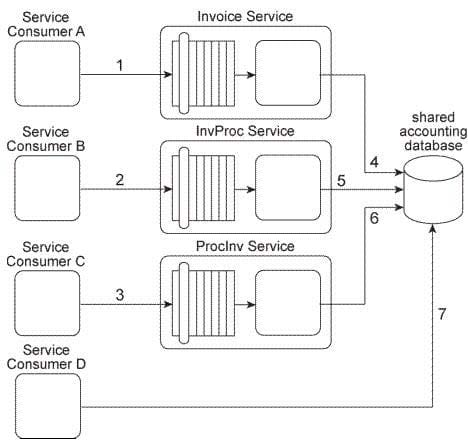
Assuming that the Invoice service, InvProc service, and ProcInv service are part of the same service inventory, what steps would be required to fully apply the Official Endpoint pattern?
A. One of the invoice-related services needs to be chosen as the official service providing invoice data access capabilities. Service Consumers A, B, and C then need to be redesigned to only access the chosen invoice-related service. Because Service Consumer D does not rely on an invoice-related service, it is not affected by the Official Endpoint pattern and can continue to access the accounting database directly. The Service Abstraction principle can be further applied to hide the existence of the shared accounting database and other implementation details from current and future service consumers.
B. One of the invoice-related services needs to be chosen as the official service providing invoice data access capabilities. Service Consumers A, B, and C then need to be redesigned to only access the chosen invoice-related service. Service Consumer D also needs to be redesigned to not access the shared accounting database directly, but to also perform its data access by interacting with the official invoice-related service. The Service Abstraction principle can be further applied to hide the existence of the shared accounting database and other implementation details from current and future service consumers.
C. Because Service Consumers A, B, and C are already carrying out their data access via published contracts, they are not affected by the Official Endpoint pattern. Service Consumer D needs to be redesigned to not access the shared accounting database directly, but to perform its data access by interacting with the official invoice-related service. The Service Abstraction principle can be further applied to hide the existence of the shared accounting database and other implementation details from current and future service consumers.
D. None of the above.
Services A, B, and C are non-agnostic task services. Service A and Service B use the same shared state database to defer their state data at runtime.
An assessment of these three services reveals that each contains some agnostic logic, but because it is bundled together with the non-agnostic logic, the agnostic logic cannot be made available for reuse.
The assessment also determines that because Service A and Service B and the shared state database are each located in physically separate environments, the remote communication required for Service A and Service B to interact with the shared state database is causing an unreasonable decrease in runtime performance.
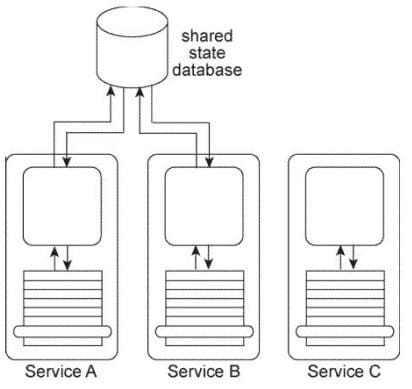
You are asked to redesign this architecture in order to increase the opportunity for agnostic service logic to be reused and in order to decrease the runtime processing demands so that performance can be improved. What steps can be taken to achieve these goals?
A. The Enterprise Service Bus pattern can be applied to establish an environment whereby the Process Abstraction and Process Centralization patterns are naturally applied, resulting in a clean separation of non-agnostic task services from newly designed agnostic services that are further shaped into reusable services by the application of the Service Reusability principle.
B. The Process Centralization pattern can be applied, resulting in a redesign effort where agnostic logic is removed from the three task services so that they only encapsulate non- agnostic logic. The agnostic logic is then moved to one or more new agnostic services that are shaped into reusable services by the application of the Service Reusability principle. The Process Abstraction pattern is then applied to the redesigned task services Service A and Service B, so that their logic is physically centralized, turning them into orchestrated task services.
C. The Process Abstraction pattern can be applied, resulting in a redesign effort where agnostic logic is removed from the three task services so that they only encapsulate non- agnostic logic. The agnostic logic is then moved to one or more new agnostic services that are shaped into reusable services by the application of the Service Reusability principle. The Orchestration pattern can be further applied to establish an environment whereby the Process Centralization pattern is naturally applied to Services A and B and the State Repository pattern in naturally applied to further help avoid remote communication by providing a local and centralized state database that can be shared by both services.
D. None of the above.
Service Consumer A sends a message to Service A. Before the message arrives with Service A, it is intercepted by Service Agent A (1). which checks the message for compliance to Policy A that is required by Service A. If the message fails compliance, Service Agent A will not allow it to proceed and will instead write the message contents to a log. If the message does comply to the policy, it continues to be transmitted toward Service A, but before it arrives it is intercepted by Service Agent B (2), which validates the security credentials in the message header. If the security credential validation fails, the message is rejected and a runtime exception is raised. If the security credentials are validated, the message is sent to Service A.
Upon receiving the message, Service A retrieves a data value from a database and populates the message header with this data value (3) prior to forwarding the message to Service B. Before the message arrives at Service B. it is intercepted by Service Agent C (4) which checks the message for compliance with two policies: Policy B and Policy C. Policy B is identical to Policy A that was checked by Service Agent
A. To check for compliance to Policy C. Service Agent C uses the data value added by Service A. If the message complies with both of the policies, it is forwarded to Service B (5), which stores the message contents in its own database.
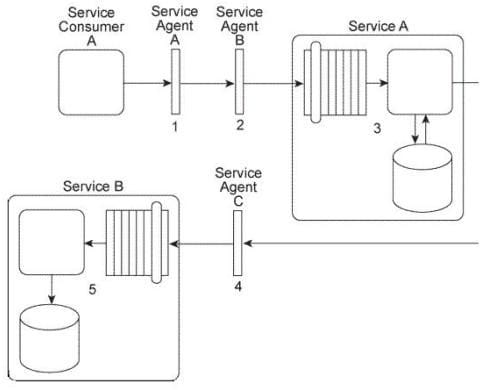
You are told that Policy B and Policy C have changed. Also, in order to carry out the compliance check of Policy C, Service Agent C will now require a new data value from the Service B database. How can this service composition architecture be changed to fulfill these new requirements?
A. The Policy Centralization pattern can be applied so that only one service agent is used to enforce Policy A and Policy B. Service A is redesigned to first query Service B for the value required by Service Agent C to check the compliance of the updated Policy C. If the compliance check is successful, the message is sent to Service B .
B. The Policy Centralization pattern can be applied so that only one service agent is used to enforce Policy A and Policy B. Service Consumer A is redesigned to first query Service B for the value required by Service Agent C. This way, Service Consumer A can include this value in the message header prior to sending the message to Service A .
C. The Policy Centralization pattern can be applied so that only one service agent is used to enforce Policy A and Policy B. The policy enforcement logic for Policy C is removed from Service Agent C and instead embedded within the logic of Service B . This way, Service B can itself retrieve the value required to check compliance with Policy C. If the message received is not in compliance, Service B will reject it.
D. None of the above.
Service A sends a message to Service B (1). After Service B writes the message contents to Database A
(2) it issues a response message back to Service A (3). Service A then sends a message to Service C (4). Upon receiving this message, Service C sends a message to Service D (5), which then writes the message contents to Database B (6) and issues a response message back to Service C (7).
Service A and Service D are in Service Inventory A. Service B and Service C are in Service Inventory B.

You are told that in this service composition architecture, all four services are exchanging invoice-related data in an XML format. However, the services in Service Inventory A are standardized to use a different XML schema for invoice data than the services in Service Inventory B. Also, Database A can only accept data in the Comma Separated Value (CSV) format and therefore cannot accept XML formatted data. Database B only accepts XML formatted data. However, it is a legacy database that uses a proprietary XML schema to represent invoice data that is different from the XML schema used by services in Service Inventory A or Service Inventory B. What steps can be taken to enable the planned data exchange between these four services?
A. The Data Model Transformation pattern can be applied so that data model transformation logic is positioned between Service A and Service B, between Service C and Service D, and between the Service D logic and Database B. The Data Format Transformation pattern can be applied so that data format transformation logic is positioned between Service A and Service C, and between the Service B
logic and Database A.
B. The Data Model Transformation pattern can be applied so that data model transformation logic is positioned between the Service B logic and Database A. The Data Format Transformation pattern can be applied so that data format transformation logic is positioned between Service A and Service B, between Service A and Service C, between Service C and Service D, and between the Service D logic and Database B.
C. The Data Model Transformation pattern can be applied so that data model transformation logic is positioned between Service A and Service B, between Service A and Service C, between Service C and Service D, and between the Service D logic and Database B. The Data Format Transformation pattern can be applied so that data format transformation logic is positioned between the Service B logic and Database A.
D. None of the above.
Service Consumer A sends a message with a business document to Service A (1), which writes the business document to Database A (2). Service A then forwards the business document to Service B (3), which writes the business document to Database B (4).
Service B then responds to Service A with a message containing a failure or success code (5) after which Service A responds to Service Consumer A with a message containing a failure or success code (6). Upon receiving the message, Service Consumer A updates a log table in Database B (7). The log entry is comprised of the entire business document. Database A is dedicated to the Service A service architecture and Database B is a shared database.
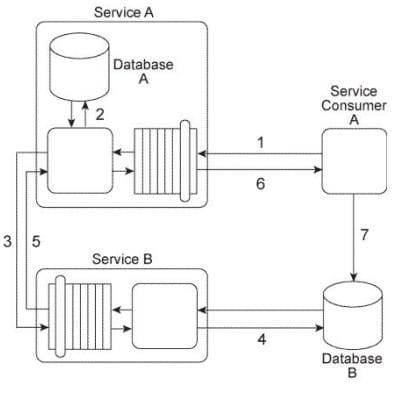
You are told that the database updates performed by Service A and Service B must be either both successful or they cannot happen at all. The database update performed by Service Consumer A must happen after it is given the outcome of the database updates performed by Service A and Service B . Given that Service Consumer A must also update Database B as part of this service composition architecture, how is it possible to fulfill these requirements?
A. The State Repository pattern can be applied so that Service A writes the business document data to a separate state database until it receives a response message from Service B . If the response message contains a success code, Service A writes the business document to Database A. If the response contains a failure code, Service A discards the data that was written to the state database.
B. The Service Data Replication pattern can be applied to Service Consumer A and Service B so that separate dedicated databases can be established allowing Service Consumer A to make updates independently of Service B . Service A is simply redesigned to not write the business document to Database A until after it receives a message containing a success code from Service B.
C. The Atomic Service Transaction pattern can be applied to encompass Service A, Service B and Service Consumer A. This will guarantee that all of the actions performed by the service composition participants will either be successful or will be rolled back if anyone is not successful.
D. None of the above.
Service Consumer A invokes Service A (1). The logic within Service A is required to retrieve three independent data values from Services B, C, and D and to then return these data values back to Service Consumer A.
To accomplish this, Service A begins by sending a request message to Service B (2). After receiving a response message with the first data value from Service B, Service A sends a request message to Service C (3). After it receives a response message with the second data value from Service C, Service A then sends a request message to Service D (4). Upon receiving a response message with the third data value from Service D. Service A finally sends its own response message (containing all three collected data values) back to Service Consumer A.
Service Consumer A and Service A reside in Service Inventory A. Service B and Service C reside in Service Inventory B. Service D is a public service that can be openly accessed via the World Wide Web. The service is also available for purchase so that it can be deployed independently within IT enterprises.
Due to the rigorous application of the Service Abstraction principle within Service Inventory B, the only information that is made available about Service B and Service C are the published service contracts. For Service D, the service contract plus a Service Level Agreement (SLA) are made available. The SLA indicates that Service D has a planned outage every night from 11 PM to midnight.
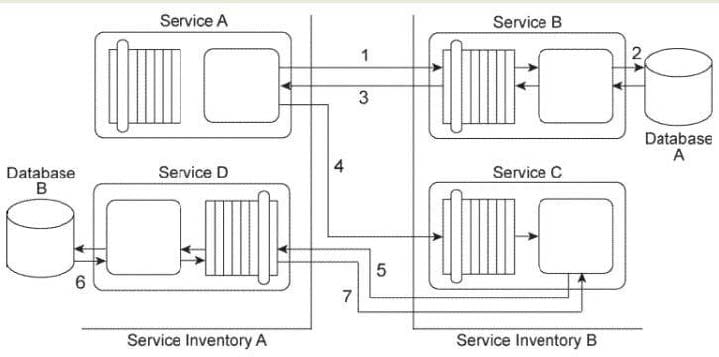
You are an architect with a project team building services for Service Inventory A . You are told that the owners of Service Inventory A and Service Inventory B are not generally cooperative or communicative. Cross-inventory service composition is tolerated, but not directly supported. As a result, no SLAs for Service B and Service C are available and you have no knowledge about how available these services are. Based on the service contracts you can determine that the services in Service Inventory B use different data models and a different transport protocol than the services in Service Inventory A. Furthermore, recent testing results have shown that the performance of Service D is highly unpredictable due to the heavy amount of concurrent access it receives from service consumers from other organizations. You are also told that there is a concern about how long Service Consumer A will need to remain stateful while waiting for a response from Service A . What steps can be taken to solve these problems?
A. The Event-Driven Messaging pattern is applied so that a subscriber-publisher relationship is established between Service Consumer A and Service A . This gives Service A the flexibility to provide its response to Service Consumer A whenever it is able to collect the three data values without having to require that Service Consumer A remain stateful. The Asynchronous Queuing pattern is applied so that a central messaging queue is positioned between Service A and Service B and between Service A and Service C . The Data Model Transformation and Protocol Bridging patterns are applied to enable communication between Service A and Service B and between Service A and Service C . The Redundant Implementation pattern is applied so that a copy of Service D is brought in- house and made part of Service Inventory A.
B. The Asynchronous Queuing pattern is applied so that a central messaging queue is positioned between Service A and Service B and between Service A and Service C and so that a separate messaging queue is positioned between Service A and Service Consumer
C. The Data Model Transformation and Protocol Bridging patterns are applied to enable communication between Service A and Service B and between Service A and Service C . The Redundant Implementation pattern is applied so that a copy of Service D is brought in- house for fail-over purposes. The Legacy Wrapper pattern is further applied to wrap Service D with a standardized service contract that is in compliance with the design standards used in Service Inventory
A. This wrapper utility service first attempts to access the external service, but if that service is
unavailable it will access the redundant internal service instead.
D. The Reliable Messaging pattern is applied so that a system of acknowledgements is established between Service Consumer A and Service A . This gives Service A the flexibility to provide Service Consumer A with acknowledgements that indicate that the processing steps that are occurring between Service A and Service B, Service C, and Service D are progressing. The Asynchronous Queuing pattern is applied so that a central messaging queue is positioned between Service A and Service B and between Service A and Service C and between Service A and Service D . The Data Model Transformation and Protocol Bridging patterns are applied to enable communication between Service A and Service B and between Service A and Service C .
E. None of the above.
Upon reviewing these requirements it becomes evident to you that the Orchestration compound pattern will need to be applied. However, there are additional requirements that need to be fulfilled. To build this service composition architecture, which patterns that is not associated with the Orchestration compound pattern need to also be applied? (Be sure to choose only those patterns that relate directly to the requirements described above. Patterns associated with the Orchestration compound pattern include both the required or core patterns that are part of the basic compound pattern and the optional patterns that can extend the basic compound pattern.)
A. Atomic Service Transaction
B. Compensating Service Transaction
C. Data Format Transformation
D. Data Model Transformation
E. Event-Driven Messaging
F. Intermediate Routing
G. Policy Centralization
H. Process Centralization
I. Protocol Bridging
J. Redundant Implementation
K. Reliable Messaging
L. Service Data Replication
M. State Repository