
TEAS-SECTION-2 Online Practice Questions and Answers
Prokaryotic and eukaryotic cells are similar in having which of the following?
A. Presence of a nucleus
B. Protein-studded DNA
C. Integral membrane proteins in the plasma membrane
D. Membrane-bound organelles
Which of these statements regarding facilitated diffusion across a cell membrane is true?
A. It is a kind of active transport (i.e., does directly use energy such as hydrolysis of ATP) that requires protein pumps.
B. It is a kind of passive transport (i.e., does not directly use energy such as hydrolysis of ATP) that does not require transmembrane/carrier proteins.
C. It is a kind of passive transport (i.e., does not directly use energy such as hydrolysis of ATP) that requires transmembrane/carrier proteins.
D. It is a kind of active transport (i.e., does directly use energy such as hydrolysis of ATP) that requires transmembrane/carrier proteins.
Phalanges are bones present in which parts of the body?
A. fingers and toes
B. cranium/skull
C. fingers only
D. ears
Fill in the blank:
The hepatic portal vein carries __________, __________ blood from the __________ to the __________.
A. deoxygenated, nutrient-rich, intestines, liver
B. deoxygenated, nutrient-rich, liver, stomach
C. deoxygenated, nutrient-poor, liver, intestines
D. oxygenated, nutrient-rich, intestines, liver
Which of these is an example of protein-related malnutrition?
A. scurvy
B. kwashiorkor
C. rickets
D. anemia
Maturation and development of T cells takes place in which region?
A. spleen
B. bone marrow
C. lymph nodes
D. thymus gland
Which of these statements is false regarding blood cells?
A. Mature red blood cells are oval, bi-concave discs with a lifespan of 120 days.
B. White blood cells are larger and less abundant than red blood cells.
C. Phagocytes and lymphocytes are the most numerous types of white blood cells.
D. Mature red blood cells are bi-concave discs that have a central nucleus and long life span.
During inhalation, what changes occur in the diaphragm?
A. The diaphragm muscles relax, making it dome-shaped.
B. The diaphragm muscles contract or tighten and move upward.
C. The abdominal muscles contract, making the diaphragm move upward.
D. The diaphragm muscles contract or tighten and the diaphragm moves downward.
The volume of air that remains present in the lungs, even after forceful expiration/exhalation, is called __________ and is about __________ liters.
A. residual volume, 0.5 liters
B. vital volume, 2 liters
C. residual volume, 1.2 liters
D. tidal volume, 2.4 liters
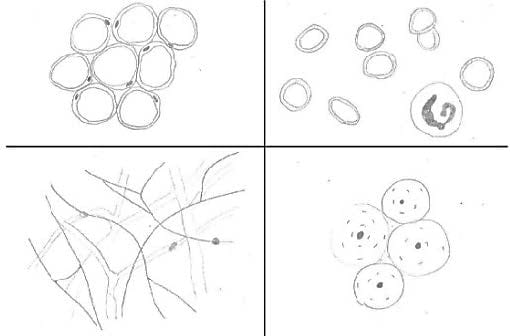
The attached diagram shows four varieties of one type of tissue.
Name the type of tissue and the four varieties.
A. connective: adipose, blood, areolar, and bone
B. epithelial: transitional, stratified, columnar, and cuboidal
C. nervous: grey matter, white matter, dendritic, and ganglion
D. connective: adipose, cardiac, transitional, and bone