
VCS-256 Online Practice Questions and Answers
An administrator needs to set up a three-node cluster with the following characteristics:
The cluster manages an application that depends on a database.
The application and database can be online on the same or a different node.
If the database faults, the application must continue to be online.
Which type of service group dependency should be created to ensure this behavior?
A. online global soft, where the application is the parent
B. online global soft, where the database is the parent
C. online global firm, where the application is the parent
D. online global firm, where the database is the parent
An administrator wants to configure a custom event trigger to be invoked when the online script fails to execute and ManageFaults = NONE. Which trigger should the administrator configure?
A. resstatechange
B. resfault
C. postonline
D. resadminwait
An administrator is evaluating the suitability of an application to be clustered using Veritas InfoScale Availability. Which condition prevents the application from being made highly available?
A. The application requires the use of solid state drives for performance.
B. The application requires multiple systems accessing shared data simultaneously.
C. The application has a dependency on the host name of the system on which it is running.
D. After a crash, the automated clean-up takes at least one minute before the application can be restarted.
Refer to the configuration.
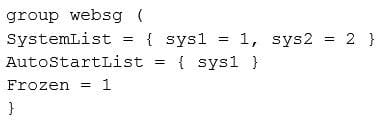
What will happen to the websg service group if the websg is online when all the systems in the cluster are rebooted simultaneously, then all the systems finish booting and successfully join the cluster?
A. it will unfreeze on reboot and start on sys1
B. it will remain offline on all systems
C. it will return to the state it was in prior to the reboot
D. it will start on sys1 in a frozen state
Which behavior should an administrator expect when using the Veritas InfoScale Availability online upgrade process using the installer?
A. The cluster remains online and the kernel processes are swapped during the upgrade process.
B. The cluster is taken offline one node at a time during the package upgrade.
C. The cluster is taken offline during the upgrade process, but the applications stay online.
D. The cluster remains online until the next reboot and an alternative boot disk is used.
The Oracle database administrator needs to shut down the Veritas Cluster Server (VCS) controlled database to apply patches. The manual shutdown the database may cause VCS to fail over the service group. Which command can the administrator run to prevent VCS from responding to the intentional Oracle database shutdown?
A. hagrp –flush
B. hagrp –freeze
C. hatype –freeze Oracle
D. hares –ignoreparent
An administrator wants to place an existing application under high availability control. Which requirement must be met to place the application under high availability control?
A. The application must have defined start, stop, and monitor procedures.
B. The application must have an unlimited license model.
C. The application must have an enterprise agent available on SORT.
D. The application must run in kernel space.
Which agent is used to automatically refresh fencing keys if they are missing on fencing servers or disks?
A. Fencing agent
B. Phantom agent
C. CoordPoint agent
D. Notifier agent
A cluster has two high-priority LLT links and one low-priority link. The low-priority link is used for public network traffic. What is the state of the cluster if both high-priority links fail simultaneously?
A. All nodes remain in regular GAB membership, but are also in jeopardy membership.
B. The cluster is in a split-brain condition until at least one other LLT link is working.
C. The fencing race is initiated and service groups are failed over the winning nodes.
D. Service groups are unable to failover when resource faults occur, but can failover if a system fault occurs.
What are two effects of a failed resource in the service group configuration below? (Select two.)
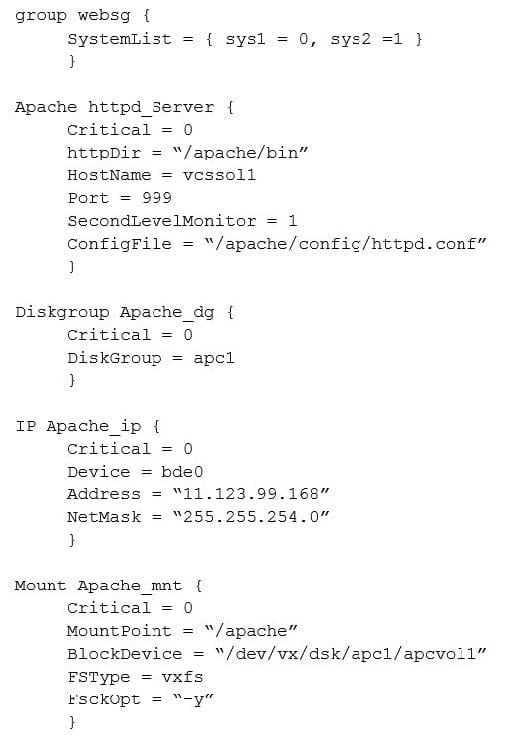
A. Any resource fault leads to a faulted state for the resource.
B. Any resource fault leads to the service group failing over.
C. Any resource fault leads to the service group being taken offline.
D. Any resource fault leaves the service group partially online.
E. Any resource fault leaves the service group fully online.