
5V0-41.20 Online Practice Questions and Answers
Scenario 2:
After completing the branch activation activities for all required branches, the administrator attempts to test connectivity between the various branches and between the hubs and branches- The administrator notices a lack of connectivity despite being certain that configurations have been complete. The administrator also observed that several users are reporting intermittent connectivity to some of the applications they are accessing. Other users are reporting no access to these applications. Other users at some of the branches claim they cannot get to certain public resources. The administrator wants to ensure that all sites can talk to each other and all resources are accessible.
Exhibit.
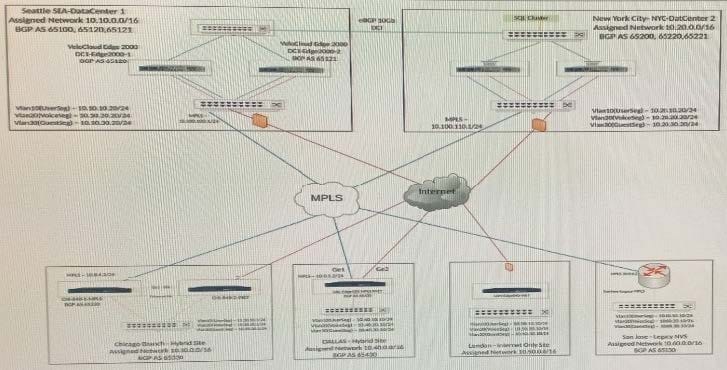
The tunnel from the Dallas site to the Seattle hub is not coming up.
What are two things that should be checked to determine the issue? (Choose two.)
A. Hub WAN Interface might be behind a firewall.
B. Spoke Edge and Hub Edge have a mismatched certificate.
C. Dynamic Branch to Branch is not enabled.
D. Spoke Edge and Hub Edge are two different Edge models.
Scenario 3:
After resolving numerous connectivity issues throughout the various branch sites, connectivity between applications and users is finally present. The network administrator is informed that during certain tests, applications are not performing as they are expected to. Users report that call quality has not fully improved and that some of their calls either drop or have poor voice quality where the conversation is breaking up. Other users are noticing that file transfers are slower than expect. A group of users from a few sites have reported slowness in accessing internal and external applications.
Exhibit.
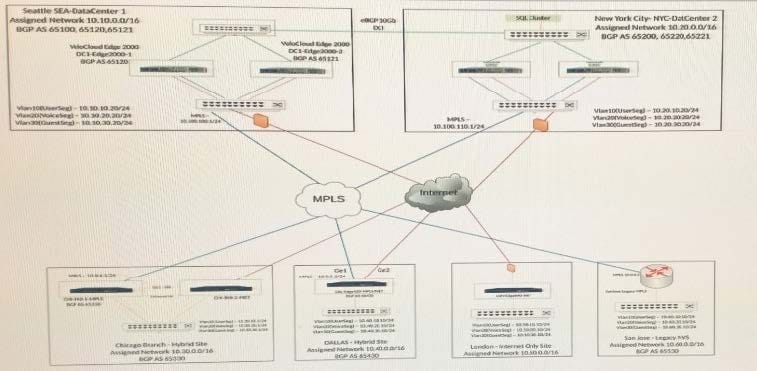
A network administrator is receiving complaints that a real-time voice application is not performing well, with choppy audio, and dead audio especially during peak traffic times.
What two actions can the administrator take to diagnose and fix the issue? (Choose two.)
A. Configure a QoS policy to rate limit all traffic during peak times.
B. Ensure that the realtime application is matching the correct application type using the diagnostics page.
C. Check the status of the links using the QoE and Transport tabs for any degraded underlay issues or congestion issues.
D. Configure a QoS policy to load balance the realtime traffic across all links.
Scenario 2:
After completing the branch activation activities for all required branches, the network administrator attempts to test connectivity between the various branches and between the hubs and branches. The administrator notices a lack of connectivity despite being certain that configurations have been complete. The administrator also observed that several users are reporting intermittent connectivity to some of the applications they are accessing. Other users are reporting no access to these applications. Other users at some of the branches claim they cannot get to certain public resources. The administrator wants to ensure that all sites can talk to each other and all resources are accessible.
Exhibit.
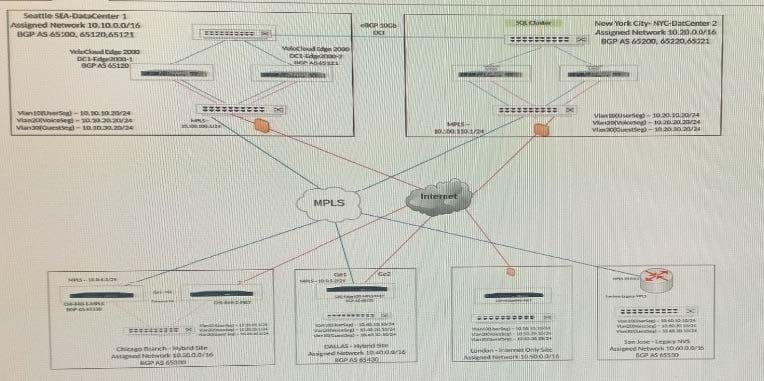
A network administrator has received an email from the applications development team requesting connectivity to their AWS VPC.
The administrator has configured the tunnel via the VMware SD-WAN Gateway. The tunnel status icon has not turned green.
Where are two places the administrator must check? (Choose two.)
A. Determine if the DH parameter on the Edge has been configured.
B. Determine if the PSK is mismatched between the AWS side and the VeloCloud Edge.
C. Determine if the NVS has been enabled and assigned to a profile.
D. Determine if the PSK is mismatched between the AWS side and the VeloCloud Gateway.
Scenario 3:
After resolving numerous connectivity issues throughout the various branch sites, connectivity between applications and users is finally present. The network administrator is informed that during certain tests, applications are not performing as they are expected to. Users report that call quality has not fully improved and that some of their calls either drop or have poor voice quality where the conversation is breaking up. Other users are noticing that file transfers are slower than expect. A group of users from a few sites have reported slowness in accessing internal and external applications.
Exhibit.
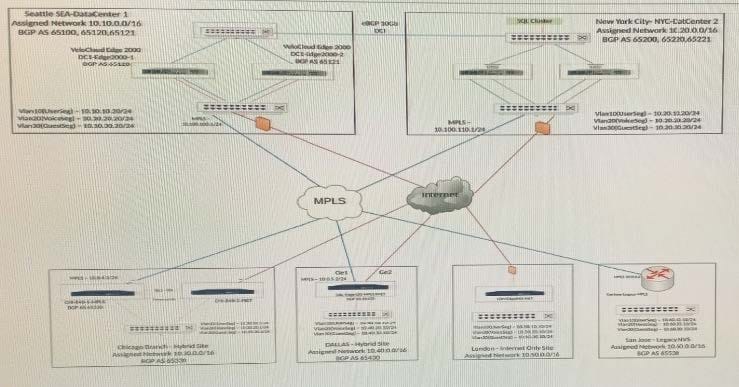
Users at the Dallas Branch are complaining that downloads/uploads from Office365 are slow. Working in Teams has been providing slow responses. The Internet circuit is 100Mbps while the MPLS Circuit is 45Mbps. Upon troubleshooting, the network administrator has noticed the traffic is Backhauling through the Seattle hub for all internet traffic.
How should the network administrator resolve the issue?
A. Leave the system as is, the gateways will resolve the issues after doing 15 minutes of link qualification.
B. Advertise public routes to Office365 and Teams through the New York Hub.
C. Leave the system as is, the hubs will auto-rebalance tunnels after doing 15 minutes of link qualification.
D. Prevent the hub from advertising a default route.
Scenario 2:
After completing the branch activation activities for ail required branches, the network administrator attempts to test connectivity between the various branches and between the hubs and branches. The administrator notices a lack of connectivity despite being cert configurations have been complete. The administrator also observed that several reporting intermittent connectivity to some of the applications they are accessing. Other users are reporting no access to these applications. Other users at some of the branches claim they cannot get to certain public resources. The administrator wants to ensure that all sites can talk to each other and all resources are accessible.
Exhibit.
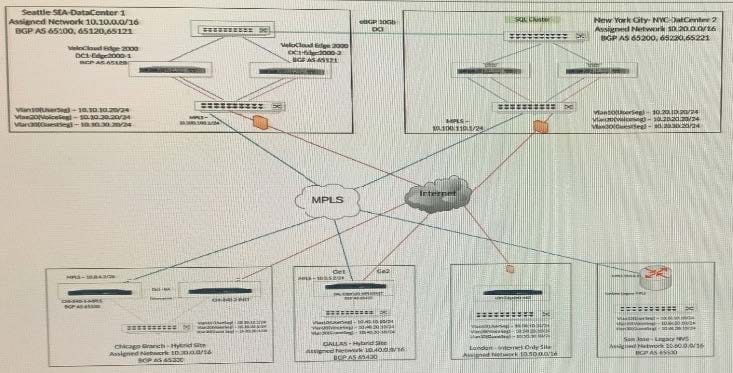
A network administrator has been told that Dallas needs some high-availability in the event that the SDWAINJ Edge goes offline for whatever reason. There is limited budget so the administrator must use the other available CE router as a fallback mechanism. The administrator will use VRRP to provide HA. When configuring VRRP, the SD-WAN Edge service restarted.
What caused this behavior?
A. The administrator failed to specify the Edge Type as a VeloCloud Cluster.
B. This is an expected behavior.
C. The device is faulty and will need a replacement.
D. The administrator failed to specify the Edge Type as a VeloCloud Active Standby Pair.
Scenario 2:
After completing the branch activation activities for all required branches, the network administrator attempts to test connectivity between the various branches and between the hubs and branches. The administrator notices a lack of connectivity despite being certain that configurations have been complete. The administrator also observed that several users are reporting intermittent connectivity to some of the applications they are accessing. Other users are reporting no access to these applications. Other users at some of the branches claim they cannot get to certain public resources. The administrator wants to ensure that all sites can talk to each other and all resources are accessible.
Exhibit.

A network administrator decides to deploy a local Checkpoint VNF appliance on the Edge in London to cut back on unnecessary traffic towards the NY Hub location. While attempting to deploy the VNF, the process keeps failing.
Where can the administrator check to see more detail?
A. VCO > Monitor > Logging
B. VCO > Monitor > Events
C. VCO > Test and Troubleshoot > Remote Diagnostics > Events
D. VCO > Test and Troubleshoot > Remote Actions > Alerts
Scenario 2:
After completing the branch activation activities for all required branches, the network administrator attempts to test connectivity between the various branches and between the hubs and branches. The administrator notices a lack of connectivity despite being certain that configurations have been complete. The administrator also observed that several users are reporting intermittent connectivity to some of the applications they are accessing. Other users are reporting no access to these applications. Other users at some of the branches claim they cannot get to certain public resources. The administrator wants to ensure that all sites can talk to each other and all resources are accessible.
Exhibit.
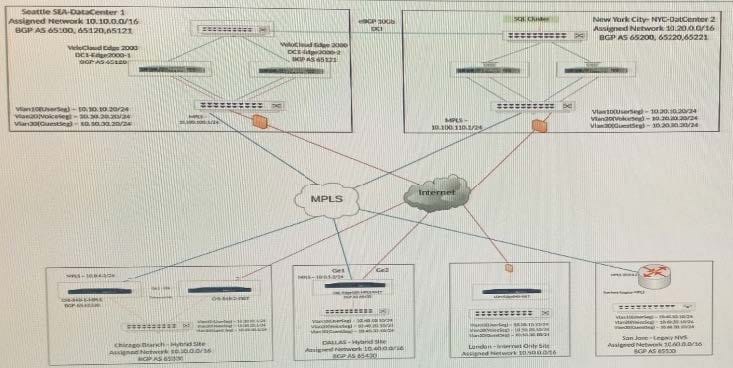
When checking connectivity from the San Jose branch, all users report that they can reach certain resources at the main data center. They are unable to reach locations elsewhere. The network administrator investigates and first looks at the Overlay Flow Control (OFC) Table.
What should the network administrator look for next to determine what the issue might be?
A. Check with the local network administrator to see if the routes for the SD-WAN sites are present in San Jose's branch router.
B. Check Test and Troubleshoot and review a route table dump of the NY hub site.
C. Check the Global Segment Configuration to see if it has the Routing Flag enabled.
D. Determine if OSPF has been configured on the MPLS Routers at the hub.
Scenario 3:
After resolving numerous connectivity Issues throughout the various branch sites, connectivity between applications and users is finally present. The network administrator is informed that during certain tests, applications are not performing as they are expected to. Users report that call quality has not fully improved and that some of their calls either drop or have poor voice quality where the conversation is breaking up. Other users are noticing that file transfers are slower than expect. A group of users from a few sites have reported slowness in accessing internal and external applications.
Exhibit.
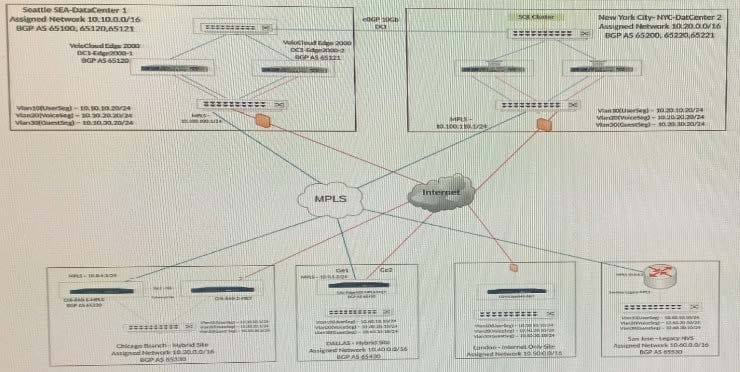
The network administrator has been made aware that Chicago is receiving traffic from non- SD-WAN sites, bottlenecking Chicago's interfaces. The network administrator's VMware SE has mentioned using the uplink feature to help resolve this.
What are two ways the uplink feature should be used in this scenario? (Choose two.)
A. Set the uplink community to forward traffic to a group of neighbors.
B. Direct all traffic to that neighbor designated as an uplink,
C. Stop mutual redistribution of routes from underlay and overlay.
D. Prevent the site in question from becoming a transit site.
Scenario 3:
After resolving numerous connectivity Issues throughout the various branch sites, connectivity between applications and users is finally present- The network administrator is informed (hat during certain tests, applications are not performing as they are expected to. Users report that call quality has not fully improved and that some of their calls either drop or have poor voice quality where the conversation is breaking up. Other users are noticing that file transfers are slower than expect. A group of users from a few sites have reported slowness in accessing internal and external applications.
Exhibit.
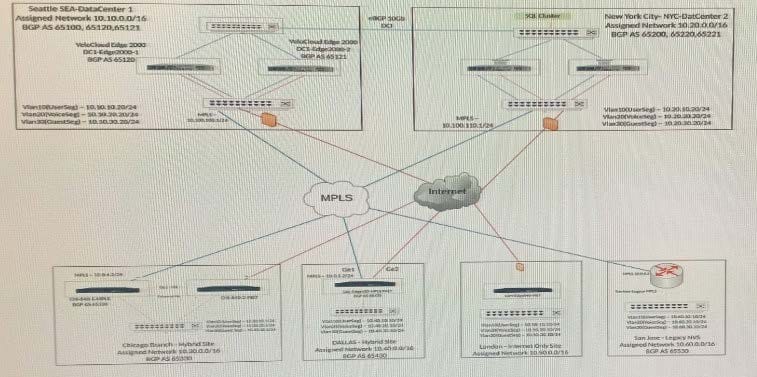
Which metrics can a network administrator verify in the QoE screen to determine the overall health of Underlay and Overlay?
A. Jitter Packet Loss, Speed.
B. Jitter, Packet Loss, Latency.
C. Jitter, Speed, Latency.
D. Packet Loss, Latency, Speed.
Scenario 2:
After completing the branch activation activities for all required branches, the network administrator attempts to test connectivity between the various branches and between the hubs and branches. The administrator notices a lack of connectivity despite being certain that configurations have been complete. The administrator also observed that several users are reporting intermittent connectivity to some of the applications they are accessing. Other users are reporting no access to these applications. Other users at some of the branches claim they cannot get to certain public resources. The administrator wants to ensure that all sites can talk to each other and all resources are accessible.
Exhibit.
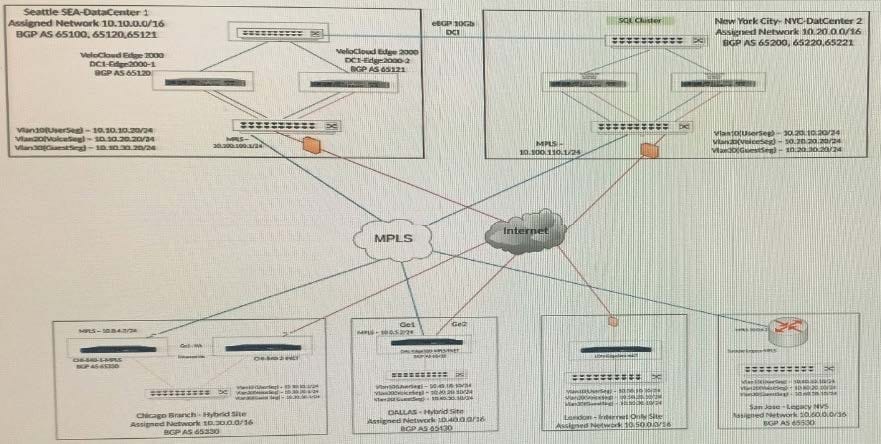
One branch location is not able to communicate with another branch location via dynamic branch-tobranch tunnels. While troubleshooting at the Edge configuration level, the network administrator notices Cloud VPN is not enabled and is grayed out, preventing them from enabling that feature.
A. Where is the next location to check for and enable the necessary feature?
B. Within the Configuration section under Profiles. Within the Monitor section under Network Services.
C. Within the Test and Troubleshooting section under Remote Diagnostics.
D. Within the Configuration section under Customer VPN enablement.