
642-243 Online Practice Questions and Answers
In a Cisco Unified Contact Center Enterprise system, a new agent and phone have been added to the system; however, the agent is unable to log in to the system.
The agent is using the same type of phone and and has the same CTI OS desktop setup as other agents who are able to log in without issue.
What are two possible causes for this issue?(Choose two.)
A. The incorrect CTIOS Server IP and Port are configured on the new agent's CTI desktop.
B. The new phone used by the agent is not associated with IVRJtapiUser.
C. A new Device Target needs to be added for the phone in the Config (for example, /devtype ipphone / DN 12345).
D. The phone has call forwarding and call waiting enabled.
E. The new phone used by the agent is not associated with PGJtapiUser.
Refer to the exhibit. In a Cisco Unified Contact Center Enterprise deployment, the call flow allows the caller to opt out and leave a voice-mail message for an agent team while in queue. The Cisco Unified IP IVR application "Script1.aef" is called to prompt the caller and transfer the call to voice mail. What impact does the script shown in the exhibit have on the system?
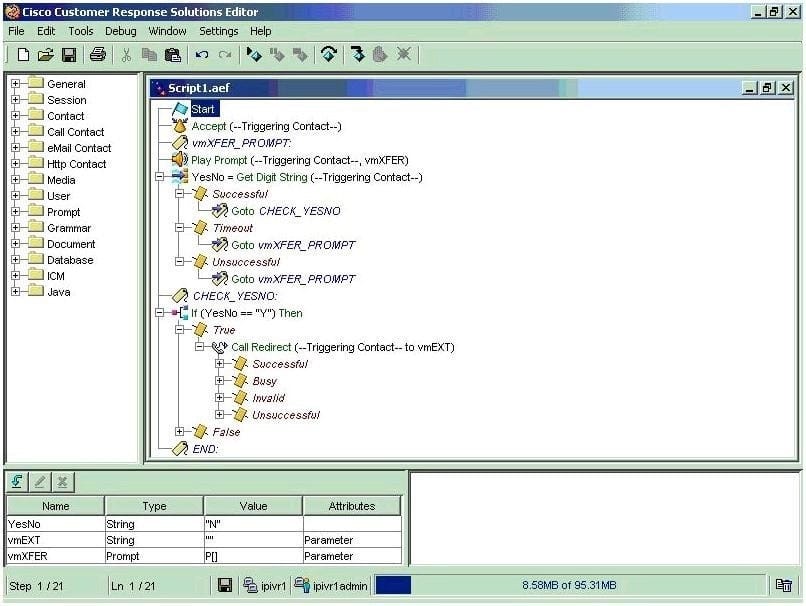
A. Calls that are sent to voice mail from the Cisco Unified IP IVR script will appear as "Abandoned" in the Cisco Unified CCE Call Type reporting.
B. Calls that are sent to voice mail from the Cisco Unified IP IVR script will appear as "Transferred Out" in the Cisco Unified CCE Call Type reporting.
C. Calls that are sent to voice mail from the Cisco Unified IP IVR script will appear as "Handled" in the Cisco Unified CCE Call Type reporting.
D. All calls that are sent to this script will be sent to the vmEXT using the Call Redirect step.
E. Callers will remain in queue after they leave the voice-mail message.
To use the Cisco Unified ICM dumplog utility to gather the Call Router's MDS log from Monday, March 10, 2008, beginning at 9:30, and to ensure that you do not get binary data in the log, which command line syntax would you use?
A. dump mds /bt 09:30 /nobinary /o
B. dumplog mds /bd 03/10/2008 /9:30 /o
C. dumplog mds /bd 03/10/2008 /bt 09:30 /nobin /o
D. dumplog /bd 03/10/2008 /bt 09:30 /nobin /o
Refer to the exhibit. In a Cisco Unified Contact Center Enterprise call flow, the Cisco Unified IP IVR application is used to queue calls during business hours, or plays the system generated "goodbye" prompt. In testing this call flow, all callers are hearing the "goodbye" prompt, even during business hours. In order to correct this error, which Cisco Unified IP IVR step needs to be moved in the flow shown in the exhibit?

A. Get Enterprise Call Info step
B. If step
C. Play Prompt ("goodbye") step
D. Play Prompt ("ICMStayOnline") step
E. Label ("PlayPrompt:") step
Refer to the exhibit. In this Cisco Unified Contact Center Enteprise system design:
All calls come into the US Data Center for treatment or queuing in a local Cisco Unified IP IVR Agents are located in a call center in the US and India and there are also Mobile Agents in their local countries using "nailed-up" connections via the local PSTN All agents are using CTI OS for their agent desktop, using a specific connection profile to define the appropriate silent monitoring method for their location
In this design, a Supervisor in the US wants to monitor agents in India. What are the possible combinations that will allow that to happen? (Choose two.)
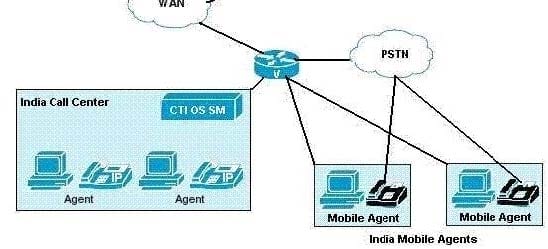
A. The Supervisor logs in using the "Desktop Monitoring" profile and can monitor any CTI OS agent in India.
B. The Supervisor logs in using the "Desktop Monitoring" profile and can monitor the Mobile Agents in India.
C. The Supervisor logs in using the "Desktop Monitoring" profile and can monitor the internal or local Call Center Agents in India.
D. The Supervisor logs in using the "India-CTI OS Silent Monitor Server" profile and can monitor any CTI OS agent in India.
E. The Supervisor logs in using the "India-CTI OS Silent Monitor Server" profile and can monitor the Mobile Agents in India.
F. The Supervisor logs in using the "India-CTI OS Silent Monitor Server" profile and can monitor the internal or local Call Center Agents in India.
Refer to the exhibit. In a Cisco Unified Contact Center Enterprise deployment, the Cisco Unified ICM Call Routing Script shows one call failed in the Translation Route to VRU node. How will the system treat this call?
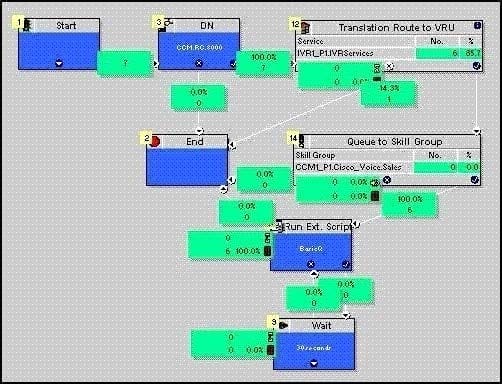
A. If a Default Route is configured on the Peripheral, the call is redirected to the number configured under "Forward On Failure" on the CTI Route Point used for the Dialed Number in Cisco Unified Communications Manager.
B. The caller would hear the default error prompt from the Cisco Unified IP IVR.
C. The script would return the label 8000, so the call is redirected to the extension 8000 in Cisco Unified Communications Manager.
D. If a Default Route is configured on the Peripheral, the call is rerouted to the Default Route.
Refer to the exhibit. In a Cisco Unified Contact Center Enterprise system, callers have reported that their calls are dropping intermittently without hearing any greetings or queue music. At times they are able to hear Cisco Unified IP IVR
prompts but are then dropped before connecting to an agent.
The Cisco Unified Communications Manager is configured as follows for this deployment:
All CTI Route Points that make requests to Cisco Unified ICM have names that start with "IPCC."
All CTI Route Points used for Cisco Unified ICM Translation Routing to the Cisco Unified IP IVR are named starting with "Trans."
All CTI Ports used by the Cisco Unified IP IVR are named starting with "CTI."
All Agent Phones are named starting with "SEP."
There is concern about how these devices are associated in the Cisco Unified Communications Manager configuration. The device associations for the PGuser and IVRuser are shown in the exhibit.
Given the problem and the current device associations, what two things might be causing these call failures? (Choose two.)

A. "Enable CTI Application Use" is not checked on the PGuser and IVRuser configurationoptions
B. The Peripheral Gateway and Cisco Unified IP IVR do not use the PGuser nor IVRuser Cisco Unified Communications Manager user accounts
C. CTI_1300 and TransRtPT3 should not be associated with the PGuser Cisco Unified Communications Manager user account
D. All devices should be associated with both the PGuser and IVRuser Cisco Unified Communications Manager user accounts
E. The Agent IP Phone 3001 should not be associated with the IVRuser Cisco Unified Communications Manager user account
F. The problem is not with the configuration. The Cisco Unified Communications Manager database subscription is broken on subscribers
Refer to the exhibit. In a Cisco Unified Contact Center Enterprise deployment using the Multi-Site Centralized call processing model, all calls come into the central site for treatment or queuing and are then transferred across the WAN to agents. In this deployment, agents have reported that they are getting stuck in a reserved state but not getting the actual call delivered to them. What is the most likely cause of this failure?
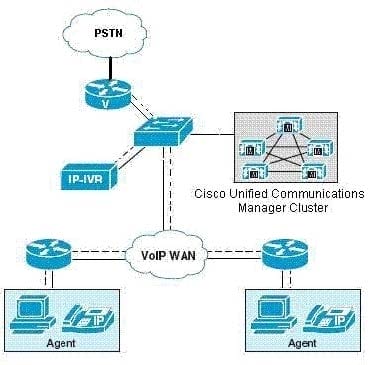
A. There are not enough Cisco Unified IP IVR ports available to queue calls at the central site.
B. The agents have lost connection to the centralized CTI OS Servers.
C. The agent's phone was off-hook during the transfer from the Cisco Unified IP IVR.
D. There was not enough bandwidth for the call over the WAN, and the Cisco Unified Communications Manager's Locations-based Call Admission Control rejected the call setup.
In the Cisco Unified Contact Center Enterprise system, there are several key utilities and commands that can be used to verify the state of a logged in agent. Which two of these tools or lines of syntax should be used to perform this test? (Choose two.)
A. C:\>rttest /cust UCCE /node RouterARTTEST Release 7.0.0.0 , Build 14833rttest: list_agent_status /agent 5001
B. C:\>rttest /cust UCCE /node RouterARTTEST Release 7.0.0.0 , Build 14833rttest: agent_status /agent
C. C:\>opctest /cust UCCE /node PG1AOPCTEST Release 7.0.0.0 , Build 14833opctest: list_agents
D. C:\>procmon UCCE PG1A pim1>>>>pim_list_agents
E. C:\>opctest /cust UCCE /node PG1AOPCTEST Release 7.0.0.0 , Build 14833opctest: dump_agents 5000 /agent 67172900
Choose the correct sequence of agent state events from Agent Login to Agent Logout in the Cisco Unified Contact Center Enterprise solution.
A. login, not ready, ready, available, reserved, talking, hold, wrap up, logout
B. login, ready, available, reserved, talking, hold, wrap up, not ready, logout
C. login, not ready, ready, available, reserved, hold, wrap up, not ready, logout
D. login, not ready, ready, available, reserved, talking, hold, wrap up, not ready, logout