
SBAC Online Practice Questions and Answers
FILL BLANK
Read the text and answer the question.
Blue Crabs Provide Evidence of Oil Tainting Gulf Food
Weeks ago, before engineers pumped in mud and cement to plug the gusher, scientists began finding specks of oil in crab larvae plucked from waters across the Gulf coast.
The government said last week that three-quarters of the spilled oil has been removed or naturally dissipated from the water. But the crab larvae discovery was an ominous sign that crude had already infiltrated the Gulf's vast food web – and
could affect it for years to come.
"It would suggest the oil has reached a position where it can start moving up the food chain instead of just hanging in the water," said Bob Thomas, a biologist at Loyola University in New Orleans.
"Something likely will eat those oiled larvae . . . and then that animal will be eaten by something bigger and so on."
Tiny creatures might take in such low amounts of oil that they could survive, Thomas said. But those at the top of the chain, such as dolphins and tuna, could get fatal "megadoses."
Marine biologists routinely gather shellfish for study. Since the spill began, many of the crab larvae collected have had the distinctive orange oil droplets, said Harriet Perry, a biologist with the University of Southern Mississippi's Gulf Coast
Research Laboratory.
"In my 42 years of studying crabs I've never seen this," Perry said.
She wouldn't estimate how much of the crab larvae are contaminated overall, but said about 40 percent of the area they are known to inhabit has been affected by oil from the spill.
While fish can metabolize dispersant and oil, crabs may accumulate the hydrocarbons, which could harm their ability to reproduce, Perry said in an earlier interview with Science magazine.
She told the magazine there are two encouraging signs for the wild larvae – they are alive when collected and may lose oil droplets when they molt.
Tulane University researchers are investigating whether the splotches also contain toxic chemical dispersants that were spread to break up the oil but have reached no conclusions, biologist Caz Taylor said.
If large numbers of blue crab larvae are tainted, their population is virtually certain to take a hit over the next year and perhaps longer, scientists say. The spawning season occurs between April and October, but the peak months are in July
and August.
How large the die-off would be is unclear, Perry said. An estimated 207 million gallons of oil have spewed into the Gulf since an April 20 drilling rig explosion triggered the spill, and thousands of gallons of dispersant chemicals have been
dumped.
Scientists will be focusing on crabs because they're a "keystone species" that play a crucial role in the food web as both predator and prey, Perry said.
Richard Condrey, a Louisiana State University oceanographer, said the crabs are "a living repository of information on the health of the environment."
Named for the light-blue tint of their claws, the crabs have thick shells and 10 legs, allowing them to swim and scuttle across bottomlands. As adults, they live in the Gulf's bays and estuaries amid marshes that offer protection and abundant
food, including snails, tiny shellfish, plants and even smaller crabs. In turn, they provide sustenance for a variety of wildlife, from redfish to raccoons and whooping cranes.
Adults could be harmed by direct contact with oil and from eating polluted food. But scientists are particularly worried about the vulnerable larvae.
That's because females don't lay their eggs in sheltered places, but in areas where estuaries meet the open sea. Condrey discovered several years ago that some even deposit offspring on shoals miles offshore in the Gulf.
The larvae grow as they drift with the currents back toward the estuaries for a month or longer. Many are eaten by predators and only a handful of the 3 million or so eggs from a single female live to adulthood.
But their survival could drop even lower if the larvae run into oil and dispersants.
"Crabs are very abundant. I don't think we're looking at extinction or anything close to it," said Taylor, one of the researchers who discovered the orange spots.
Still, crabs and other estuary-dependent species such as shrimp and red snapper could feel the effects of remnants of the spill for years, Perry said.
"There could be some mortality, but how much is impossible to say at this point," said Vince Guillory, biologist manager with the Louisiana Department of Wildlife and Fisheries.
Perry, Taylor and Condrey will be among scientists monitoring crabs for negative effects such as population drop-offs and damage to reproductive capabilities and growth rates.
Crabs are big business in the region. In Louisiana alone, some 33 million pounds are harvested annually, generating nearly $300 million in economic activity, Guillory said.
Blue crabs are harvested year-round, but summer and early fall are peak months for harvesting, Guillory said.
Prices for live blue crab generally have gone up, partly because of the Louisiana catch scaling back due to fishing closures, said Steve Hedlund, editor of SeafoodSource.com, a website that covers the global seafood industry.
Fishers who can make a six-figure income off crabs in a good year now are now idled – and worried about the future.
"If they'd let us go out and fish today, we'd probably catch crabs," said Glen Despaux, 37, who sets his traps in Louisiana's Barataria Bay. "But what's going to happen next year, if this water is polluted and it's killing the eggs and the larvae? I
think it's going to be a long-term problem."
Excerpt from "Blue Crabs Provide Evidence of Oil Tainting Gulf Food Web" by John Flesher. Copyright © 2010 by The Associated Press. Reprinted by permission of The Associated Press.
Summarize the author's point about why scientists are monitoring the blue crab population so closely. Support your summary using key evidence from the text.
A.
See explanation below.
Read the attachments
Attachment 1
How to fight drug-resistant bacteria
This year, the U.S. reported for the first time that a patient had been infected by bacteria resistant to colistin, an antibiotic of last resort. The announcement followed several years of warnings that current antibiotics aren't diverse enough to
fight pathogens as drug resistance spreads. The cover story of Chemical and Engineering News (CandEN), the weekly newsmagazine of the American Chemical Society, sums up how researchers are trying to stay ahead of the bugs. Ann M.
Thayer, a senior correspondent at CandEN, notes that antibiotic-resistant pathogens already cause at least 2 million illnesses and 23,000 deaths each year in the U.S. alone. And the development pipeline for new treatments to deal with this
growing problem is anemic. About 40 small molecules and two dozen other approaches, such as antibodies and vaccines, are in clinical testing. Only about one in five are expected to earn approval for patient use. In addition, sparse funding,
poor business prospects and regulatory issues can stand in the way of development.
Despite the hurdles, there is hope. Researchers are getting creative in their strategies for defeating infection-causing bacteria. They're designing drugs to overcome existing resistance mechanisms. Their tactics include making drugs that
attack pathogens on multiple fronts, and that neutralize illness-causing bacterial toxins rather than killing the bugs themselves. To help encourage the development of new solutions, policymakers are proposing various bills to ease the
financial and regulatory burdens. And new government and nonprofit funding is becoming available.
Attachment 2
Paraphrase A:
Researchers continue to pursue the quest to find alternative solutions to drug resistant deadly bacteria. They are exploring alternative approaches and with the support of government and nonprofit agency funding, may be getting closer to
new drug options.
Paraphrase B:
Scientists are working hard to beat drug-resistant, infection-causing bacteria. Researchers are developing drugs that can outsmart a bacteria's current means of resistance. This includes designing drugs that assault pathogens in multiple
ways and can diffuse the toxins that cause the illness rather than killing the bacteria itself. Policymakers are trying to help support the research into new drugs by proposing bills that will help lessen the financial and regulatory burdens that
currently slow down the process and the government and nonprofit agencies are also providing research funding.
Paraphrase C:
Scientists have hope, despite the challenges they face. Researchers are getting fancy in devising strategies for defeating infection-causing bacteria. Drugs designed to overcome existing resistance mechanisms are being developed. They are
focusing on making drugs that attack pathogens on multiple fronts, and neutralize illness-causing bacterial toxins rather than destroying the bugs themselves. Policymakers hope to encourage the development of new solutions by proposing
legislative bills to ease the financial and regulatory burdens, with new government and nonprofit funding also becoming available.
Paraphrase D:
Researchers are desperately searching for new alternatives to treat patients who may become infected with drug-resistant strains of bacteria. Although it seems an uphill battle, they are hopeful that new drug treatment options for patients
who are stricken with bacterial infections may soon be available and will save countless lives worldwide. Scientists are looking in to newly designed drugs that attack the offending bacteria in different ways. They are also trying to determine
how to neutralize the bacterial toxins that cause illness as opposed to killing the bacteria completely. They are getting creative in their approach on how to handle this increasing health concern. In support of these scientific advances,
government policymakers are working to get bills passed that will help ease the financial burden companies face in trying to conduct this critical research and cut back on some of the regulatory hurdles that make drug approval such a time-
consuming process. In addition to government support and assistance, nonprofit agencies are also providing private funding options.
Which of the choices in the attachment 2 is the best paraphrase of paragraph 2 of the attachment 1?
A. paraphrase D
B. paraphrase B
C. paraphrase C
D. paraphrase A
These six sentences could form a paragraph. What is the best order to put them in to create an organized, cohesive paragraph?
1.
Western culture has only recently "accepted" tattoos.
2.
Before the 1970s, tattoos were generally reserved for soldiers or sailors, but their popularity has grown over the past few years.
3.
Tattoos are a form of body modification and self-expressive "art."
4.
Now it is common to see tattoos of all shapes and sizes on people from all walks of life.
5.
Many cultures have used tattoos as a rite of passage or to indicate social rank or status for hundreds of years.
6.
Each has its own significance and meaning to the individual person.
A. sentence 3, sentence 5, sentence 1, sentence 2, sentence 4, sentence 6
B. sentence 5, sentence 1, sentence 2, sentence 6, sentence 4, sentence 3
C. sentence 1, sentence 3, sentence 5, sentence 4, sentence 6, sentence 2
D. sentence 4, sentence 6, sentence 5, sentence 1, sentence 3, sentence 2
A certain sequence is defined this way:
f(1) = 2 and f(n) = f(n − 1) +3
Which of the following statements are true?
a ) The sequence is arithmetic.
b ) The sequence is geometric.
c ) The definition is explicit.
d ) The definition is recursive.
e ) The 7th term is 20.
f ) The 5th term is 12 more than the first term
A. b, c, e, f
B. a, d, e, f
C. a, c, f
D. b, d, e

Aimee plans to open a lemonade stand. She wants to determine whether to sell an 8 ounce or 10 ounce cup of lemonade. Each 8-ounce cup costs 2 cents and 10 ounce cups are 3 cents each. The lemons to make a half-gallon of lemonade cost 5 dollars and the sugar for the half-gallon costs 85 cents. She already has all the materials needed to make the stand and she can use the location at no cost. Aimee notices that about 150 people pass by the location of her stand each day and thinks that 20 percent of these people will buy a cup of lemonade. You have made the 2 accompanying graphs to help Aimee make business decisions.
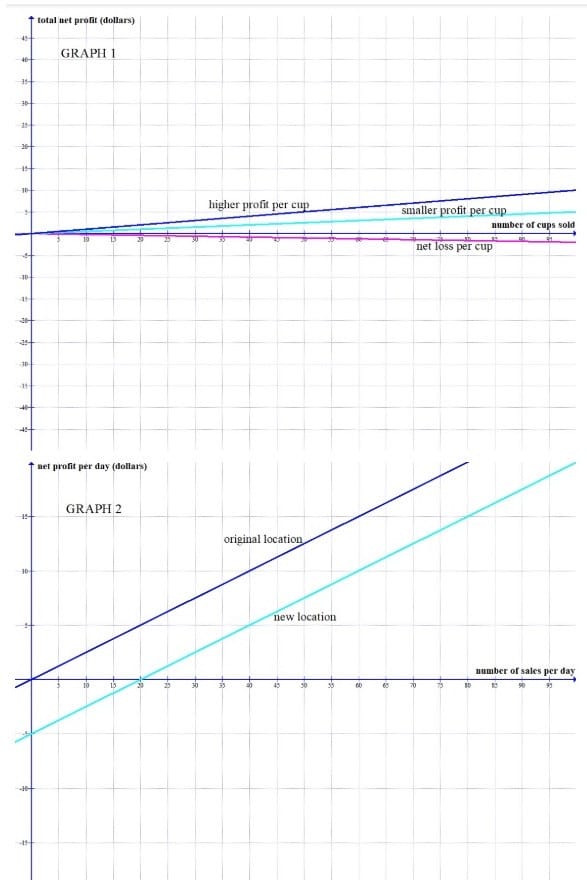
Read the attached passage and consult the attached graphs. Which of these unit conversions will you need to use to calculate the costs per cup?
1.
dollars to cents
2.
gallons to ounces
3.
gallons to cups
4.
pounds to ounces
A. conversions 1 and 2
B. conversion 3 only
C. conversions 1 and 4
D. conversion 2 only
Aimee plans to open a lemonade stand. She wants to determine whether to sell an 8 ounce or 10 ounce cup of lemonade. Each 8-ounce cup costs 2 cents and 10 ounce cups are 3 cents each. The lemons to make a half-gallon of lemonade cost 5 dollars and the sugar for the half-gallon costs 85 cents. She already has all the materials needed to make the stand and she can use the location at no cost. Aimee notices that about 150 people pass by the location of her stand each day and thinks that 20 percent of these people will buy a cup of lemonade. You have made the 2 accompanying graphs to help Aimee make business decisions.
Read the attached passage and consult the attached graphs.
Aimee has made this ordered list of the steps she will need to take to calculate a daily profit. You point out that she forgot to include the cost per cup for 8 or 10 ounces. Where in the list should this step be inserted?
Step 1–Calculate cost per ounce of lemonade for lemons.
Step 2–Calculate cost per ounce of lemonade for sugar.
Step 3–Calculate the profit per cup.
Step 4–Estimate the number of cups sold each day.
Step 5–Estimate the profit for each day.
A. between steps 2 and 3
B. between steps 3 and 4
C. between steps 1 and 2
D. before step 1
Aimee plans to open a lemonade stand. She wants to determine whether to sell an 8 ounce or 10 ounce cup of lemonade. Each 8-ounce cup costs 2 cents and 10 ounce cups are 3 cents each. The lemons to make a half-gallon of lemonade cost 5 dollars and the sugar for the half-gallon costs 85 cents. She already has all the materials needed to make the stand and she can use the location at no cost. Aimee notices that about 150 people pass by the location of her stand each day and thinks that 20 percent of these people will buy a cup of lemonade. You have made the 2 accompanying graphs to help Aimee make business decisions.
Read the attached passage and consult the attached graph. In graph 2, which point shows the sales Aimee needs to break even at the new location?
A. the y-intercept of the "new location" line
B. the point where the 2 lines intersect
C. the intercept of the "original location" line at (0,0)
D. the x-intercept of the "new location" line
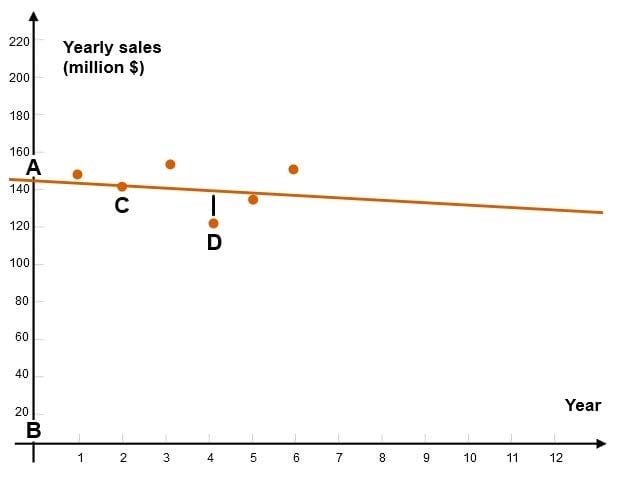
Students in a business class are studying the performance of XYZ Widgets over the past 6 years. This is a scatterplot of yearly sales and a linear model trend line of the data. Which of these best represents the line between the point at label D and the trend line in the attached graphic?
A. interquartile range
B. inercept
C. residual
D. standard deviation
Read the text and answer the question.
Moving to the Back of Beyond
When my parents said the three of us were moving out to California, to a place just north of Los Angeles, my mind immediately went to thoughts of Disneyland and Hollywood, glitz and glamour. I imagined a Rodeo Drive shopping spree to
pick out a bikini for the endless days I would be spending on the beach. However, I’d forgotten about my parents’ penchant for the unconventional; they’re definitely “the road less traveled” kind of people. Mom had a gopher snake for a pet
when she was younger, and Dad was never happier than when he was climbing near-vertical cliffs that only mountain goats could love. These are not city folk.
They had chosen to buy a 900-square-foot cabin under a 250-year-old oak tree in the high chaparral1 forest out in the back of beyond – so far away from Los Angeles that you couldn't even see the glow of the lights at night. When I first saw
where we were going to live, I vacillated between feeling terrified and excited. This would be an adventure, for sure. But this was no camping trip where you could go home to civilization after a few days of roughing it; this was home, and
roughing it was the new normal.
On move-in day, we drove fifteen miles out from Antelope Valley – where the nearest grocery store was located – on a two-lane road past llamas, cattle, and horses. Up and up we went, until finally we turned down a dirt road and headed into
a canyon full of towering Coulter pines, blue-green sagebrush, and ancient canyon live oaks. I didn't know the names of these plants then, of course; I learned them later. That first day all I saw then was a million shades of green.
We parked under an oak tree that shaded our cabin and a front yard of rock, sand, and sagebrush twice as large as the cabin itself. On the stone staircase that led to the front door, black lizards interrupted their push-ups to twist their heads
and eye us as we passed. Scrub jays squawked and hummingbirds zoomed past the eaves, scolding us with their territorial calls.
No cars roared past. No radios blared from a neighbor's house. There were no neighbors – no human neighbors, anyway.
Our new home consisted of one bedroom, one bathroom, and one big room for everything else. A fireplace in the corner of the big room would be our sole source of heat in the winter. A swamp box (cooler) would blow a breeze over a big
damp pad to keep us cool all summer, or so my father said. But it was early autumn that day, and the temperature was perfect in the shade of the oak tree. Our oak tree, I thought; I was settling in.
Mom wiped a layer of grime off the kitchen counter and muttered about getting a bottle of bleach on our next trip into town. That was the beginning of an important lesson about living in the back of beyond: you don't just zip over to the local
convenience store anytime you need something out here. You have to make a careful list and check it twice so that you don't forget anything, because anywhere is a long way from here.
On my first walk around the property, I saw two horned toads, a red-tailed hawk, and some deer tracks. I wondered what else I might find deeper and higher in the canyon. Dad told me the real estate agent had mentioned that coyotes,
bobcats, mountain lions, rattlesnakes, and even bears roamed these hills. To my surprise, I found I couldn't wait to see them. All of them. I felt my feet taking root in the earth, claiming this place as home.
With no street lamps timed to turn on at sunset, when night came it was darker than anything I had ever experienced. Mom and I went out to look at the stars while Dad tried to unplug the ancient toilet. In the city, or even in the suburbs where
I had lived before, you could see only the brightest stars in the sky. But out here, it was like being in a planetarium, except there were no labels typed onto our sky. The sheer number and spread of stars was awe-inspiring.
That first night, we slept on air mattresses on the living room floor because the movers had not yet arrived. There were no curtains on the windows, so when the moon rose, it shone in as if moonbeams were an integral part of the cabin.
Eventually, I moved into the bedroom and Mom and Dad got a foldout bed for the living room. Over the next few months, I began to count the passage of time in full moons rather than by the pages of a calendar, and for the first time I really
noticed the days growing shorter in winter and longer in summer.
It's hard to believe, but we’ve been here for six years now. I’ve been going to school in the valley, but I feel most at home up here with my wild fellow canyon dwellers. Soon, I will have to leave home for college, and I’m a little afraid of the
culture shock I’m sure I will feel when I move back to civilization. Soon I’ll be walking on pavement and well-mowed grass again, rooming with strangers, and eating meals in a cafeteria crowded with more people than live within twenty miles
of this house. But I know I will come back. The back of beyond is home now.
1. chaparral: a dense thicket of shrubs and small trees
The following question is divided into two parts. First, answer part A. Then, answer part B.
Part A
What is most likely the author's intent by mentioning the “Rodeo Drive shopping spree” in the following paragraph?
When my parents said the three of us were moving out to California, to a place just north of Los Angeles, my mind immediately went to thoughts of Disneyland and Hollywood, glitz and glamour. I imagined a Rodeo Drive shopping spree to pick out a bikini for the endless days I would be spending on the beach. However, I’d forgotten about my parents’ penchant for the unconventional; they’re definitely “the road less traveled” kind of people. Mom has a gopher snake for a pet when she was younger, and Dad was never happier than when he was climbing near-vertical cliffs that only mountain goats could love. These are not city folk.
A. to show that the narrator comes from a family that is used to spending money
B. to reveal the narrator as someone who is shallow and cares only for nice things
C. to contrast the narrator's grand dreams with the sparse life her parent have in mind
D. to emphasize the narrator's nervousness about moving to a place so far removed from civilization