

 Printable PDF
Test Prep SBAC Exam Questions & Answers
Want to pass your Test Prep SBAC exam in the very first attempt? Try Exam2pass! It is equally effective for both starters and IT professionals.
-
Vendor: Test Prep
Exam Code: SBAC
Exam Name: Smarter Balanced Assessment Consortium
Certification Provider: Test Prep
Total Questions: 224 Q&A ( View Details)
Updated on: Jul 07, 2026
Note: Product instant download. Please sign in and click My account to download your product. -
- Updated exam questions with all objectives covered
- Verified answers
- 365 days free updates
- 99% success rate
- 100% money back guarantee
- 24/7 customer support



Related Exams
- AACD American Academy of Cosmetic Dentistry
- ACLS Advanced Cardiac Life Support
- ASSET ASSET Short Placement Tests Developed by ACT
- ASSET-TEST ASSET Short Placement Tests Developed by ACT
- BUSINESS-ENVIRONMENT-AND-CONCEPTS Certified Public Accountant (Business Environment amd Concepts)
- CBEST-SECTION-1 California Basic Educational Skills Test - Math
- CBEST-SECTION-2 California Basic Educational Skills Test - Reading
- CCE-CCC Certified Cost Consultant / Cost Engineer (AACE International)
- CGFNS Commission on Graduates of Foreign Nursing Schools
- CLEP-BUSINESS CLEP Business: Financial Accounting, Business Law, Information Systems & Computer Applications, Management, Marketing
- CLEP-COMPOSITION-AND-LITERATURE CLEP Composition and Literature: American Literature, English Literature, Humanities
- CLEP-HISTORY-AND-SOCIAL-SCIENCE CLEP History and Social Sciences: American Government, Educational Psychology, History of the United States, Macroeconomics, Microeconomics, Psychology
- CLEP-SCIENCE-AND-MATHEMATICS CLEP Science and Mathematics: Biology, Calculus, Chemistry, College Algebra & Mathematics, Precalculus, Natural Sciences
- COMPASS-TEST Computer-adaptive Placement, Assessment, and Support System: English, Math, Writing
- CPA-REGULATION CPA Regulation
- FINANCIAL-ACCOUNTING-AND-REPORTING Financial Reporting
- FORKLIFT Forklift Theory
- GACE Georgia Assessments for the Certification of Educators
- GED-SECTION-1 Section One Social Studies
- GED-SECTION-2 Section Two Language Arts - Writing
- GED-SECTION-3 Section Three Science
- GED-SECTION-4 Section Four Language Arts - Reading
- GED-SECTION-5 Section Five Mathematics
- HESI-A2 HESI Admission Assessment (A2)
- HSPT High School Placement Test
- HSPT-TEST High School Placement Test
- ISEE-TEST Independent School Entrance Examination
- LEED-TEST Leadership in Energy and Environmental Design
- MACE Medication Aide Certification Examination
- MCQS Multiple-choice questions for general practitioner (GP) Doctor
Related Certifications
SBAC Online Practice Questions and Answers
Read the text attached.
Passage 1
Critical information needed in fight to save wildlife
With global temperatures rising, an international group of 22 top biologists is calling for a coordinated effort to gather important species information that is urgently needed to improve predictions for the impact of climate change on future
biodiversity. Current predictions fail to account for important biological factors like species competition and movement that can have a profound influence on whether a plant or animal survives changes to its environment, the scientists say in
the September 9 issue of the journal Science. While more sophisticated forecasting models exist, much of the detailed species information that is needed to improve predictions is lacking.
"Right now, we're treating a mouse the same way as an elephant or a fish or a tree. Yet we know that those are all very different organisms and they are going to respond to their environment in different ways," says University of Connecticut
Ecologist Mark Urban, the Science article's lead author. "We need to pull on our boots, grab our binoculars, and go back into the field to gather more detailed information if we are going to make realistic predictions."
The 22 top biologists affiliated with the article identify six key types of biological information, including life history, physiology, genetic variation, species interactions, and dispersal, that will significantly improve prediction outcomes for individual
species. Obtaining that information will not only help the scientific community better identify the most at-risk populations and ecosystems, the scientists say, it will also allow for a more targeted distribution of resources as global temperatures
continue to rise at a record rate.
Current climate change predictions for biodiversity draw on broad statistical correlations and can vary widely, making it difficult for policymakers and others to respond accordingly. Many of those predictions tend not to hold up over time if they
fail to account for the full range of biological factors that can influence an organism's survival rate: species demographics, competition from other organisms, species mobility, and the capacity to adapt and evolve. "We haven't been able to
sufficiently determine what species composition future ecosystems will have, and how their functions and services for mankind will change," says co-author Dr. Karin Johst of the Helmholtz Centre for Environmental Research and the German
Centre for Integrative Biodiversity Research. "This is because current ecological models often do not include important biological processes and mechanisms: so far only 23 percent of the reviewed studies have taken into account biological
mechanisms."
Generating more accurate predictions is essential for global conservation efforts. Many species are already moving to higher ground or toward the poles to seek cooler temperatures as global temperatures rise. But the capacity of different
organisms to survive varies greatly. Some species of frog, for instance, can traverse their terrain for miles to remain in a habitable environment. Other species, such as some types of salamander, are less mobile and capable of moving only a
few meters over generations.
"New Zealand's strong foundation in ecological research will help," explains study co-author Dr. William Godsoe, a Lincoln University lecturer and member of New Zealand's Bio-Protection Research Centre. "One of our hopes is to build on
these strengths and highlight new opportunities to improve predictions by explicitly considering evolution, interactions among species, and dispersal." This will aid in the development of strategies to manage impacts on species and
ecosystems before they become critical.
With more than 8.7 million species worldwide, gathering the necessary biological information to improve predictions is a daunting task. Even a sampling of key species would be beneficial, the authors say, as the more sophisticated models
will allow scientists to extrapolate their predictions and apply them to multiple species with similar traits.
The researchers are calling for the launch of a global campaign to be spearheaded by the Intergovernmental Science-Policy Platform on Biodiversity and Ecosystem Services or IPBES. The IPBES operates under the auspices of four United
Nations entities and is dedicated to providing scientific information to policymakers worldwide. One thousand scientists from all over the world currently contribute to the work of IPBES on a voluntary basis. The scientists are also encouraging
conservation strategies to support biodiversity such as maintaining dispersal corridors, and preserving existing natural habitats and genetic diversity.
"Our biggest challenge is pinpointing which species to concentrate on and which regions we need to allocate resources," says UConn Associate Professor Urban. In an earlier study in Science, Urban predicted that as many as one in six
species internationally could be wiped out by climate change. "We are at a triage stage at this point. We have limited resources and patients lined up at the door."
Passage 2
Forecasting climate change's effects on biodiversity hindered by lack of data
An international group of biologists is calling for data collection on a global scale to improve forecasts of how climate change affects animals and plants. Accurate model predictions can greatly aid efforts to protect biodiversity from
disturbances such as climate change and urban sprawl by helping scientists and decision-makers better understand, anticipate and respond to threats that imperil species and ecosystems.
In a paper published in Science on Thursday (Sept. 8), biologists cite a critical lack of data on key biological mechanisms ?such as how animals and plants spread during their lifetime and how they evolve in response to changes in the
environment - as the main obstacle to improving models' ability to forecast species' response to climate change.
"This paper is a call to arms," said Patrick Zollner, article co-author and Purdue associate professor of wildlife science. "The world is in dire circumstances. We're losing a lot of species, and we're largely unaware why. How do we need to
rethink the kind of data we're collecting so we can take advantage of modern modeling tools to understand the outcomes of climate change for ecological systems? This could help us forestall losing wildlife that we later deeply regret."
The group outlines two key problems that hinder the capability of current models to make realistic predictions about biological responses to climate change.
Most models are descriptive, based on statistical correlations and observations, and fail to capture the underlying processes that produce observed changes. For example, a descriptive model might show that lynx in the northern U.S. are
declining while bobcat populations in the same region are on the rise. Understanding what is driving this change requires a different sort of model, one that incorporates biological mechanisms. A mechanistic model that accounts for how
warming temperatures affect snow depth, for instance, could provide insights into why bobcats ?better adapted to habitats with less snow - are gaining a competitive edge over lynx. But 77 percent of current models of climate change's
impacts on wildlife do not include biological mechanisms.
Another challenge is that as models have grown in sophistication, they have far outpaced data collection. Put another way, a model is like a state-of-the-art kitchen, but the cupboards are bare.
"We can now build videogame-like environments with computers where we can create multiple versions of Earth and ask what the implications under different scenarios are," Zollner said. "But our ability to learn from these tools is constrained
by the kinds of data we have."
The group advanced several proposals on how to improve models, collect missing data and leverage available data to make broader predictions.
They identified six biological mechanisms that influence wildlife's responses to climate change: physiology; demography and life history; evolutionary potential and adaptation; interactions between species; movement over land or water; and
responses to changes in the environment. They ranked the information needed to account for these mechanisms in models and suggested proxies for data that are missing or hard to collect.
A globally coordinated effort to fill data gaps could greatly advance improvements in models and informed conservation approaches, the researchers wrote. They point to the Intergovernmental Panel on Climate Change and its consistent
improvements in climate change modeling as a valuable blueprint for such a project.
But local and regional conservation groups need not wait for a global body to coalesce to start using a mechanistic approach in their own region, Zollner said "If the ideas put forth in this paper start to be adopted and integrated into climate
change work in a grass roots way, that could make a big difference in a region and could scale up over time," he said.
Citizen scientists also have an important role to play in pitching in with data collection, he said.
Working with citizen scientists offers "an opportunity to get huge amounts of data, and it's foolish not to take advantage of it," Zollner said. "The data might not be as rigorous and needs to be treated differently, but it's one more source of
valuable information.
What is the effect of the last paragraph of the attached Passage 1 on the overall tone of the text?
A. It gives a sense of humor with the metaphor of triaging the patients; the reader can imagine all the species of plants and animals lined up in their hospital gowns to be seen by the scientists.
B. It gives a sense of hope; we can do this if we can pull together and conduct the necessary research.
C. It gives a sense of urgency with the metaphor about triaging; there is a recognized problem, now we need to figure out how to do something about it before things literally die.
D. It gives a sense of defeat; we are going to lose "patients" because we can't act quickly enough with the amount of research and data that we have.
You are asked to write an argumentative essay in support of paternity leave being extended to new fathers. Which of these sentences would not be important to include in support of the argument?
A. Granting men paternity leave helps increase mothers' incomes as women can re-enter the workforce sooner, giving both partners an increased sense of self-worth.
B. Studies suggest that fathers who take paternity leave have an increased role in child-care-related tasks, and their involvement may have lasting impact on their children's performance in school.
C. There is a social stigma associated with men who want to take paternity leave after the birth of a child, and he may face negative criticism for this decision from friends, coworkers, and even family members
D. A child's brain develops significantly in the weeks and months following birth, and the interactions, relationships, and experiences babies are exposed to can set the stage for the rest of their lives.
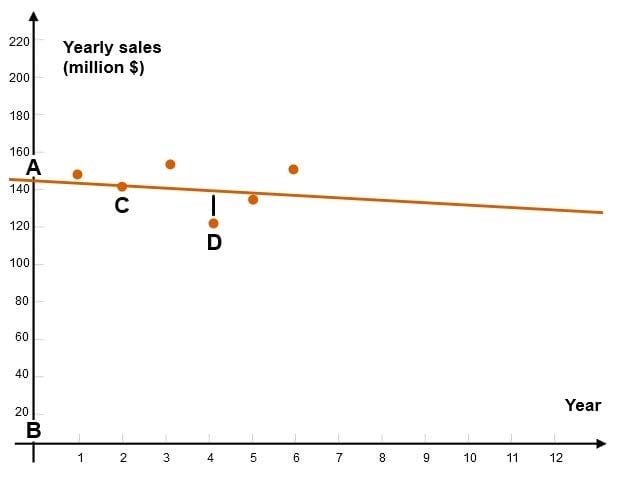
Students in a business class are studying the performance of XYZ Widgets over the past 6 years. This is a scatterplot of yearly sales and a linear model trend line of the data. Referring to the attached graph and information, which of these best describes the point on the line near label A?
A. intercept
B. slope
C. correlation coefficient
D. residual
Why Choose Exam2pass SBAC Exam PDF and VCE Simulator?
-
100% Pass and Money Back Guarantee
Exam2pass SBAC exam dumps are contained with latest SBAC real exam questions and answers. Exam2pass SBAC PDF and VCE simulator are revised by the most professional SBAC expert team. All the SBAC exam questions are selected from the latest real exam and answers are revised to be accurate. 100% pass guarantee and money back on exam failure.
-
The Most Professional Support Service
Exam2pass has the most skillful SBAC experts. Candidates can get timely help when needed. Exam2pass SBAC exam PDF and VCE simulator are the most up-to-date and valid. The most professional support service are provided to help the SBAC candidates at anytime and anywhere.
-
365 Days Free Update Download
Exam2pass SBAC exam PDF and VCE simulator are timely updated in 365 days a year. Users can download the update for free for 365 days after payment. Exam2pass SBAC exam dumps are updated frequently by the most professional SBAC expert team. SBAC candidates can have the most valid SBAC exam PDF and VCE at any time when needed.
-
Free Demo Download
Download free demo of the Exam2pass exam PDF and VCE simulator and try it. Do not need to pay for the whole product before you try the free trial version. Get familiar about the exam questions and exam structure by trying the free sample questions of the exam PDF and VCE simulator. Try before purchase now!