

 Printable PDF
SOA S90.09 Exam Questions & Answers
Want to pass your SOA S90.09 exam in the very first attempt? Try Exam2pass! It is equally effective for both starters and IT professionals.
-
Vendor: SOA
Exam Code: S90.09
Exam Name: SOA Design & Architecture Lab
Certification Provider: SOA
Total Questions: 40 Q&A ( View Details)
Updated on: Jul 02, 2026
350-001 has been changed greatly by Cisco Official in May 2014. Our 350-001 product contains the latest real exam questions and answers. 100% Pass Guarantee. Please feel free to purchase. -
- Updated exam questions with all objectives covered
- Verified answers
- 365 days free updates
- 99% success rate
- 100% money back guarantee
- 24/7 customer support



Related Exams
- S90-01A Fundamental SOA & Service-Oriented Computing (S90-01A)
- S90-02A SOA Technology Concepts (S90-02A)
- S90-03A SOA Design & Architecture (S90-03A)
- S90-08A Advanced SOA Design & Architecture (S90-08A)
- S90-09A SOA Design & Architecture Lab (S90-09A)
- S90.08B SOA Design & Architecture Lab with Services & Microservices
S90.09 Online Practice Questions and Answers
Service A is a task service that is required to carry out a series of updates to a set of databases in order to complete a task. To perform the database updates Service A must interact with three other services, each of which provides standardized data access capabilities.
Service A sends its first update request message to Service B (1), which then responds with a message containing a success or failure code (2). Service A then sends its second update request message to Service C (3), which also responds with a message containing a success or failure code (4). Finally, Service A sends a request message to Service D (5), which responds with its own message containing a success or failure code (6).
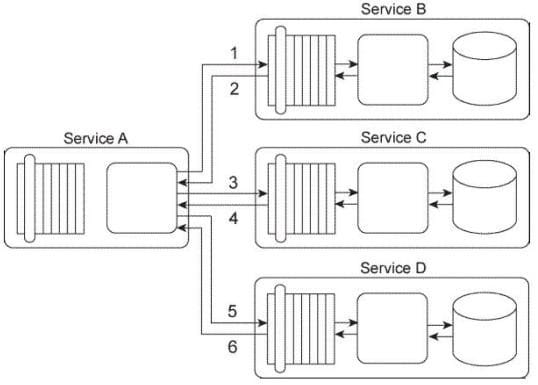
You've been asked to change this service composition architecture in order to fulfill a set of new requirements: First, if the database update performed by Service B fails, then it must be logged by Service
A. Secondly, if the database update performed by Service C fails, then a notification e-mail must be sent out to a human administrator. Third, if the database update performed by either Service C or Service D fails, then both of these updates must be reversed so that the respective databases are restored back to their original states. What steps can be taken to fulfill these requirements?
A. Service A is updated to perform a logging routine when Service A receives a response message from Service B containing a failure code. Service A is further updated to send an e-mail notification to a human administrator if Service A receives a response message from Service C containing a failure code. The Atomic Service Transaction pattern is applied so that Services A, C, and D are encompassed in the scope of a transaction that will guarantee that if the database updates performed by either Service C or Service D fails, then both updates will be rolled back.
B. The Compensating Service Transaction pattern is applied to Service B so that it invokes exception handling logic that logs failed database updates before responding with a failure code back to Service
A . Similarly, the Compensating Service Transaction pattern is applied to Service C so that it issues an e-mail notification to a human administrator when a database update fails. The Atomic Service Transaction pattern is applied so that Services A, C, and D are encompassed in the scope of a transaction that will guarantee that if the database updates performed by either Service C or Service D fails, then both updates will be rolled back. The Service Autonomy principle is further applied to Service A to ensure that it remains consistently available to carry out this sequence of actions.
C. The Atomic Service Transaction pattern is applied so that Services A, C, and D are encompassed in the scope of a transaction that will guarantee that if the database updates performed by either Service C or Service D fails, then both updates will be rolled back. The Compensating Service Transaction pattern is then applied to all services so that the scope of the compensating transaction includes the scope of the atomic transaction. The compensating exception logic that is added to Service D automatically invokes Service B to log the failure condition and Service C to issue the e-mail notification to the human administrator. This way, it is guaranteed that the compensating logic is always executed together with the atomic transaction logic.
D. None of the above.
Service Consumer A sends Service A a message containing a business document (1). The business document is received by Component A, which keeps the business document in memory and forwards a copy to Component B (3). Component B first writes portions of the business document to Database A (4).
Component B writes the entire business document to Database B and then uses some of the data values from the business document as query parameters to retrieve new data from Database B (5).
Next, Component B returns the new data back to Component A (6), which merges it together with the original business document it has been keeping in memory and then writes the combined data to Database C (7). The Service A service capability invoked by Service Consumer A requires a synchronous request-response data exchange. Therefore, based on the outcome of the last database update, Service A returns a message with a success or failure code back to Service Consumer A (8).
Databases A and B are shared and Database C is dedicated to the Service A service architecture.
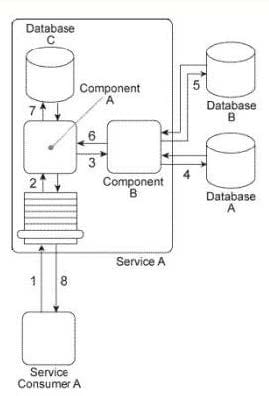
There are several problems with this architecture: The business document that Component A is required to keep in memory (while it waits for Component B to complete its processing) can be very large. Especially when Service A is concurrently invoked by multiple service consumers, the amount of runtime resources it uses to keep this data in memory can decrease the overall performance of all service instances. Additionally, because Database A is a shared database that sometimes takes a long time to respond to Component B, Service A can take a long time to respond back to Service Consumer A . Currently, Service Consumer A will wait for a response for up to 30 seconds after which it will assume the request to Service A has failed and any subsequent response messages from Service A will be rejected. What steps can be taken to solve these problems?
A. The Service Statelessness principle can be applied together with the State Repository pattern in order to extend Database C so that it also becomes a state database allowing Component A to temporarily defer the business document data while it waits for a response from Component B. The Service Autonomy principle is applied together with the Legacy Wrapper pattern to isolate Database A so that it is encapsulated by a separate wrapper utility service. The Compensating Service Transaction pattern is applied so that if the response time of Service A exceeds 30 seconds, a notification is sent to a human administrator to raise awareness of the fact that the eventual response of Service A will be rejected by Service Consumer A.
B. The Service Statelessness principle can be applied together with the State Repository pattern in order to establish a state database that Component A can defer the business document data to while it waits for a response from Component B. The Service Autonomy principle can be applied together with the Service Data Replication pattern to establish a dedicated replicated database for Component B to access instead of the shared Database
C. The Asynchronous Queuing pattern can be applied to establish a messaging queue between Service Consumer A and Service A so that Service Consumer A does not need to remain stateful while it waits for a response from Service A .
D. The Service Statelessness principle can be applied together with the State Repository pattern in order to establish a state database that Component A can defer the business document data to while it waits for a response from Component B. The Service Autonomy principle can be applied together with Service Abstraction principle, the Legacy Wrapper pattern, and the Service Facade pattern in order to isolate Database A so that it is encapsulated by a separate wrapper utility service and to hide the Database A implementation from Service A and to position a Facade component between Component B and the new wrapper service. This Facade component will be responsible for compensating the unpredictable behavior of Database A.
E. None of the above.
Service Consumer A sends a message with a business document to Service A (1), which writes the business document to Database A (2). Service A then forwards the business document to Service B (3), which writes the business document to Database B (4).
Service B then responds to Service A with a message containing a failure or success code (5) after which Service A responds to Service Consumer A with a message containing a failure or success code (6). Upon receiving the message, Service Consumer A updates a log table in Database B (7). The log entry is comprised of the entire business document.
Database A is dedicated to the Service A service architecture and Database B is a shared database.

There are two problems with this service composition architecture that you are asked to address: First, both Service Consumer A and Service B need to transform the business document data from an XML format to a proprietary Comma Separated Value (CSV) in order to write the data to Database B. This has led to redundant data format transformation logic that has been difficult to keep in synch when Database B changes. Secondly, Service A is an entity service that is being reused by several other service compositions. It has lately developed reliability problems that have caused the service to become unavailable for extended periods. What steps can be taken to solve these problems?
A. The Legacy Wrapper pattern can be applied so that data access to Database B is separated into a new wrapper utility service. This way, the Data Format Transformation pattern only needs to be applied within the logic of this new service which will expose a standardized contract that both Service Consumer A and Service B can access. The Asynchronous Queuing pattern can be applied so that messaging queues are established between Service Consumer A and Service A and between Service A and Service B . The Service Autonomy principle can be further applied to Service A in order to establish a more isolated and reliable surrounding infrastructure.
B. The Legacy Wrapper pattern can be applied so that data access to Database B is separated into a new wrapper utility service. This way, the Data Format Transformation pattern only needs to be applied within the logic of this new service which will expose a standardized contract that both Service Consumer A and Service B can access. The Reliable Messaging pattern can be applied so that acknowledgements are passed between Service Consumer A and Service A and between Service A and Service B . The Service Composability principle can be further applied to Service A in order to optimize its service architecture for improved participation in multiple service compositions.
C. The service composition can be redesigned with the application of the Contract Centralization pattern so that instead of writing the business document to Database B, Service Consumer A sends the business document to Service B instead. This way, Service B would provide the only location where data format transformation logic for Database B needs to be carried out, which further supports the application of the Service Reusability principle. The Reliable Messaging pattern can be applied so that acknowledgements are passed between Service Consumer A and Service A and between Service A and Service B . The Service Composability principle can be further applied to Service A in order to optimize its service architecture for improved participation in multiple service compositions.
D. None of the above.
Why Choose Exam2pass S90.09 Exam PDF and VCE Simulator?
-
100% Pass and Money Back Guarantee
Exam2pass S90.09 exam dumps are contained with latest S90.09 real exam questions and answers. Exam2pass S90.09 PDF and VCE simulator are revised by the most professional S90.09 expert team. All the S90.09 exam questions are selected from the latest real exam and answers are revised to be accurate. 100% pass guarantee and money back on exam failure.
-
The Most Professional Support Service
Exam2pass has the most skillful S90.09 experts. Candidates can get timely help when needed. Exam2pass S90.09 exam PDF and VCE simulator are the most up-to-date and valid. The most professional support service are provided to help the S90.09 candidates at anytime and anywhere.
-
365 Days Free Update Download
Exam2pass S90.09 exam PDF and VCE simulator are timely updated in 365 days a year. Users can download the update for free for 365 days after payment. Exam2pass S90.09 exam dumps are updated frequently by the most professional S90.09 expert team. S90.09 candidates can have the most valid S90.09 exam PDF and VCE at any time when needed.
-
Free Demo Download
Download free demo of the Exam2pass exam PDF and VCE simulator and try it. Do not need to pay for the whole product before you try the free trial version. Get familiar about the exam questions and exam structure by trying the free sample questions of the exam PDF and VCE simulator. Try before purchase now!